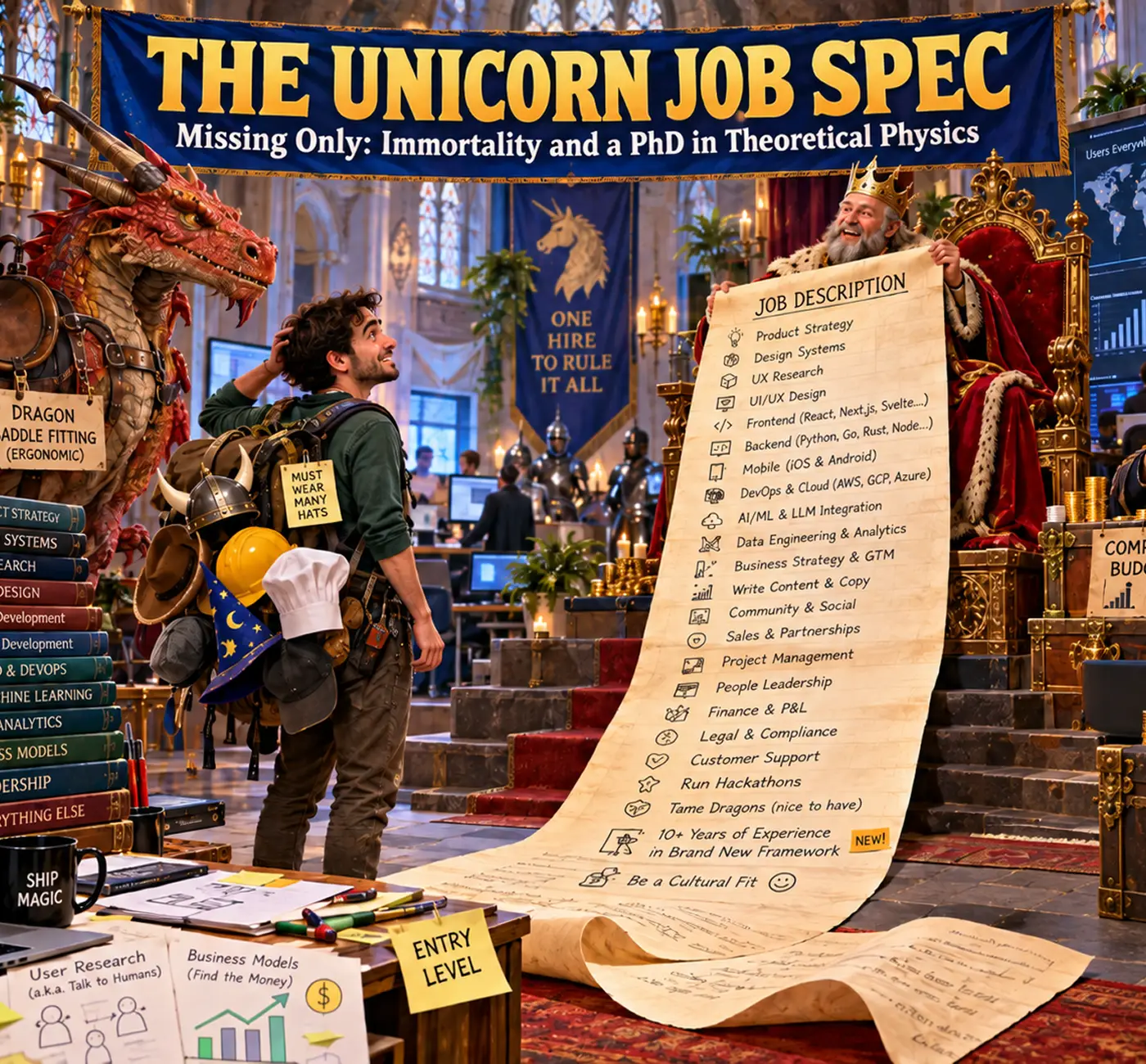
I recently reviewed a rather ambitious job specification. I am pleased to report that to satisfy every single requirement, I am missing only two minor credentials: immortality and a PhD in theoretical physics.
Tech job descriptions increasingly read like medieval royal decrees. Slaying the dragon is merely entry-level criteria. Today, a single candidate is expected to:
Define long-term product vision, strategy, and business models.
Architect enterprise-grade design systems with immaculate token hygiene.
Ship robust, scalable production code across three distinct stacks.
And, naturally, design an ergonomic saddle for the dragon, conduct user research with the local peasantry, and get the compute budget approved by the royal treasury.
All paired with a mandatory prerequisite: ten years of production experience in a framework announced eighteen months ago.
The temptation to collapse an entire cross-functional unit into a single headcount is economically understandable, if physiologically optimistic. But in practice, the all-in-one practitioner functions much like the scissors on a pocket knife: technically present, but rarely suitable for heavy lifting.
Mature organizations and experienced leadership recognize the boundary between cross-disciplinary literacy and structural wishful thinking. Resilient products are not built by mythical lone rangers attempting to do everything simultaneously; they are forged through deep domain expertise, clear ownership, and effective delegation.
Knowing when to bring in dedicated talent rather than attempting to solo the entire backlog is precisely what separates senior leadership from inevitable burnout.